



Sixteen Panel Insight Mega Cup with Adulterants (FUO)
- Screens for 16 Drugs in One Cup
- Includes Fentanyl, Tramadol, K2 Spice and EtG (Alcohol Metabolite)
- For Forensic Use Only (FUO)
- Results in 5 Minutes
- Built-In Adulterant Checks (pH, Specific Gravity, Creatinine)
- Integrated Temperature Strip
- Disposable Gloves Included
Availability: In stock
| Model | Drugs Tested |
|---|---|
| I2-DOA-6165-EFKTA3 | AMP / BAR / BUP / BZO / COC / ETG / FEN / K2 / MET / MDMA / MTD / MOP / OXY / PCP / THC / TRA |
You've just added this product to the cart:
Sixteen Panel Insight Mega Cup with Adulterants (FUO)

The Sixteen Panel Insight Mega Cup with Adulterants (FUO) is a 16-panel urine drug test cup that screens for AMP, BAR, BUP, BZO, COC, ETG, FEN, K2, MDMA, MET, MTD, OPI, OXY, PCP, THC, and TRA in a single test. Along with the standard panels, it covers specialty drugs including fentanyl, tramadol, synthetic cannabinoids (K2), and EtG, an alcohol metabolite, making it a strong choice for zero-tolerance programs. An integrated temperature strip confirms the specimen is within 90–100°F (32–38°C), and 3 built-in adulteration checks for pH, Specific Gravity, and Creatinine help identify diluted or tampered samples. Adulteration results are read at 2 minutes and drug results at 5 minutes. Disposable gloves are included. Forensic Use Only (FUO).
| All Sales Final | No |
|---|---|
| Per Case | 25 |
| Adulterants | Oxidants, pH Balance, Specific Gravity |
| FDA Cleared | No |
| For Employment and Insurance Use | No |
| Forensic only? | Yes |
PERFORMING THE TEST
Before testing:
Allow the test cup to come to room temperature [15-30℃ (59-86℉)] prior to testing.
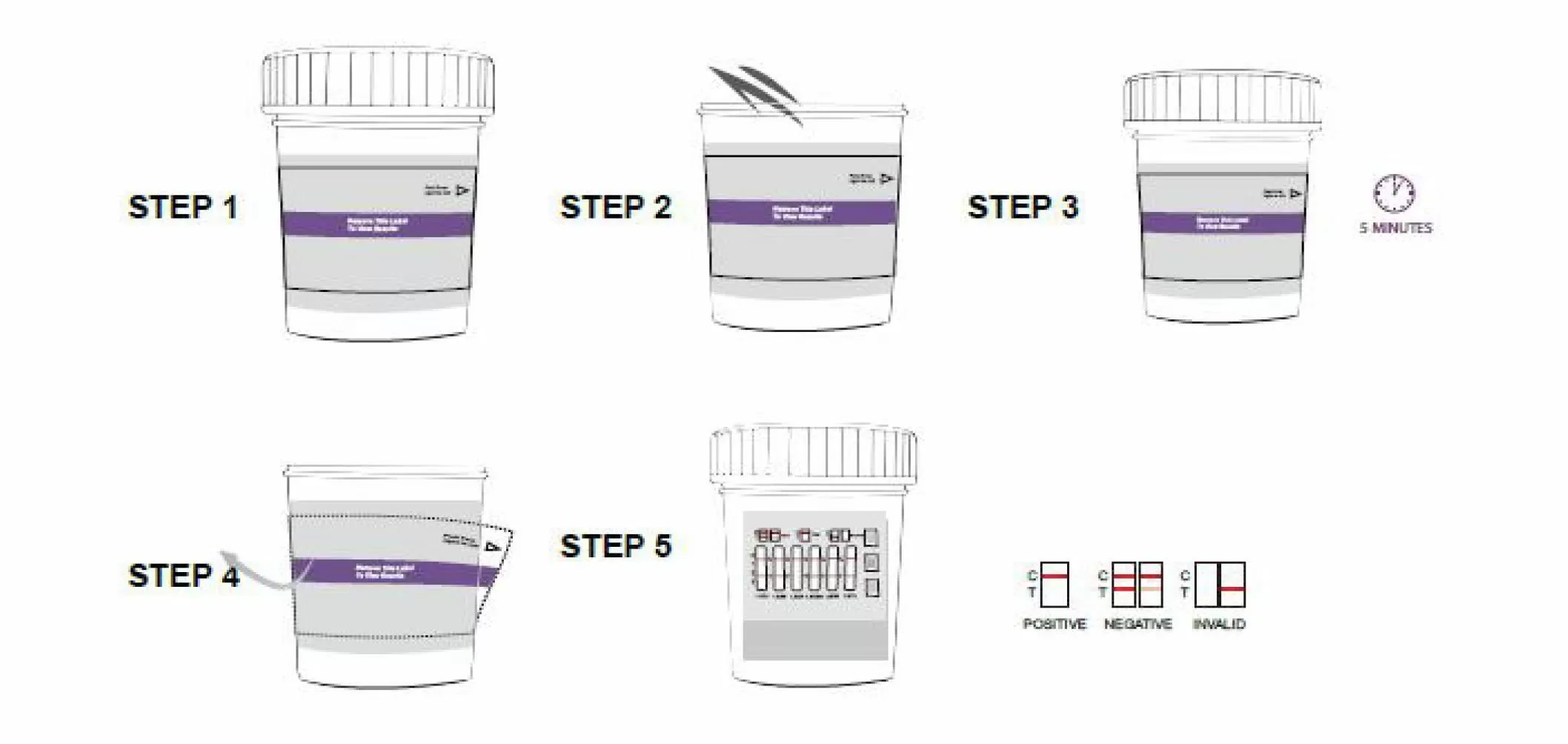
Step 1: Tear the foil bag open and remove the test cup. Label the device with donor information. (Step 1)
Step 2: Collect a minimum of 30 ml to a maximum of 110 ml of urine (marked on the cup). Once the urine specimen has been collected, screw the cap on firmly. Start the timer. (Step 2)
Step 3: Verify the urine temperature is within an acceptable range [32-38℃ (90-100℉)] by reading the green mark on the temperature indicator strip. (Step 3)
Step 4: Using the gloves provided, the collector should peel off the label to reveal the test results. (Step 4)
Step 5: Read the adulteration strip pads at 2 minutes by comparing them to the color chart card. (Step 5)
Step 6: Interpret the drug strip results at 5 minutes. DO NOT INTERPRET RESULT AFTER 10 MINUTES. (Step 5)
Step 7: If there is a preliminary positive test result, the operator should attach the security seal label over the cap. The security seal should include the donor's name, initials, and test date. Do not cover the test result window with the security seal. Send the specimen to a laboratory for confirmation.
INTERPRETATION OF RESULTS
|
Negative Result NEGATIVE: Two colored bands appear on the membrane. One band appears in the control region (C) and another band appears in the test region (T). Certain lines may appear lighter or thinner than other lines. A line is to be considered a line whether it is faint, light or dark. *NOTE: The shade of red in the test line region (Drug/T) will vary, but it should be considered negative whenever there is even a faint pink line. |
 |
|
Preliminary Positive Result: POSITIVE: Only one colored band appears, in the control region (C). No apparent colored band appears in the test region (T). This indicates the drug concentration exceeds the detectable level. The specimen should be sent to a laboratory for confirmation. |
 |
|
Invalid Result: INVALID: Control band fails to appear. Results from any test which has not produced a control band at the specific read time must be discarded. Please review the procedure and repeat with a new test. If the problem persists, discontinue using the kit immediately and contact your local distributor. |
 |
ADULTERANT INTERPRETATION
Semi-quantitative results are obtained by visually comparing the reacted color blocks on the strip to the printed color blocks on the color chart card. No instrumentation is required. If adulteration is suspected, the test should be repeated with another urine specimen and a new test cup.
STORAGE AND STABILITY
Store as packaged in the sealed pouch either at room temperature or refrigerated [2-30°C (36-86°F)]. The Test Cup is stable through the expiration date printed on the sealed pouch. The Test Cup must remain in the sealed pouch until use. Keep away from direct sunlight, moisture and heat. DO NOT FREEZE. Do not use beyond the expiration date.
Frequently Asked Questions About the 16 Panel Insight Mega Cup with Adulterants
What does the 16 panel Insight Mega Cup test for?
This 16 panel drug test cup screens a single urine sample for AMP, BAR, BUP, BZO, COC, ETG (alcohol metabolite), FEN, K2, MDMA, MET, MTD, OPI, OXY, PCP, THC, and TRA, including specialty drugs such as fentanyl, tramadol, and synthetic cannabinoids.
How accurate is the 16 panel drug test cup?
In the manufacturer's clinical study, this drug test cup showed high agreement with GC-MS laboratory confirmation across all drug panels. Like all rapid drug tests, it provides a preliminary result, so preliminary positive results should be confirmed by a laboratory.
What are adulteration checks?
Adulteration checks are specimen validity tests that help detect tampering, dilution, or substitution. This cup includes built-in testing for pH, Specific Gravity, and Creatinine. The integrated temperature strip also confirms the specimen is within 90–100°F (32–38°C) at the time of collection.
How long does it take to get results?
Adulteration results are read at 2 minutes and drug results at 5 minutes. Do not interpret results after 10 minutes.
How do I read the results?
Two lines (control and test) indicate a negative result, even if the test line is faint. A control line only, with no test line, indicates a preliminary positive. If the control line does not appear, the test is invalid and should be repeated with a new cup.
Can anything affect the results?
Yes. Certain foods, medicines, diet plan drugs, and nutritional supplements may cause a false positive. A diluted or adulterated sample may cause a false negative. A negative result does not always mean the specimen is drug-free, since drugs present below the cutoff level will not be detected.
Is this drug test cup suitable for workplace testing?
No. This drug test cup is labeled For Forensic Use Only (FUO) and is not intended for clinical diagnosis, employment, or insurance testing.
| Model | Drugs Tested: |
|---|---|
| I2-DOA-6165-EFKTA3 | AMP1000, BAR300, BUP10, BZO300, COC300, ETG300, FEN300, K2(50), MET1000, MDMA500, MTD300, MOP300, OXY100, PCP25, THC50, TRA200 |
| Drug Name | ABBR | Calibrator | Standard Cutoff Levels Urine | Standard Cutoff Levels Saliva | Approx. Detection Time Urine | Approx. Detection Time Saliva |
|---|---|---|---|---|---|---|
| Alcohol |
ALC |
Ethanol |
>0.04% |
>0.02% |
1-12 hours |
1-12 hours |
|
** |
AMP |
** |
500 & 1000 ng/ml |
50 ng/ml |
2-4 Days |
1-3 Days |
|
Barbiturates |
BAR |
Secobartbital |
300 ng/ml |
50 ng/ml |
1-3 Days |
1 Day |
|
Benzodiazepines |
BZO |
Oxazepam |
300 ng/ml |
10 ng/ml |
3-5 Days |
1 Day |
|
Buprenorphine |
BUP |
Buprenorphine |
10 ng/ml |
5 ng/ml |
3-5 Days |
1 Day |
|
Cocaine |
COC |
Benzoylecgonine |
150 & 300 ng/ml |
20 ng/ml |
2-4 Days (Single) |
1-3 Days |
|
Cotinine |
COT |
Cotinine |
200 ng/ml |
30 ng/ml |
1-3 Days |
1-4 Days |
|
Ecstasy |
MDMA |
D,L- Methylenedioxy-methamphetamine |
500 ng/ml |
NA |
1-4 Days |
1-2 Days |
|
Ethyl Glucuronide |
ETG |
Ethyl Glucuronide |
300 & 500 ng/ml |
NA |
Up to 80 Hours |
N/A |
|
** |
FEN |
** |
200 & 300 ng/ml |
10 ng/ml |
3 Days |
N/A |
|
Gabapentin |
GABA |
Gabapentin |
1000 ng/ml |
N/A |
1-2 Days |
N/A |
|
K2 / Spice |
K2/Spice |
JWH-073/JWH-018 |
50 ng/ml |
5 ng/ml |
1-3 Days |
N/A |
|
Ketamine |
KET |
Ketamine |
1000 ng/ml |
N/A |
1-3 Days |
1 Day |
|
Marijuana |
THC |
11-nor-Δ9-THC-9 COOH |
50 ng/ml |
12 ng/ml |
2-5 Days (Single) |
|
|
Methadone |
MTD |
Methadone |
50 ng/ml |
30 ng/ml |
1-7 days |
1 Day |
|
Methamphetamine |
MAMP |
D-Methamphetamine |
500 & 1000 ng/ml |
50 ng/ml |
2-4 Days |
1-3 Days |
|
Morphine |
MOP |
Morphine |
300 ng/ml |
40 ng/ml |
1-3 Days |
1-3 Days |
|
Opiates |
OPI |
Morphine |
2000 ng/ml |
|||
|
Oxycodone |
OXY |
Oxycodone |
100 ng/ml |
20 ng/ml |
1-3 Days |
1 Day |
|
Phencyclidine |
PCP |
Phencyclidine |
25 ng/ml |
10 ng/ml |
2-13 Days |
1-3 Days |
|
** |
TRA |
** |
200 ng/ml |
NA |
1-3 Days |
1 Day |
|
Tricyclic Antidepressants |
TCA |
Nortriptyline |
1000 ng/ml |
NA |
2-5 Days |
N/A |
|
Propoxyphene |
PPX |
Propoxyphene |
300 ng/ml |
NA |
1-7 Days |
N/A |
|
*The above chart gives approximate detection periods for each substance by test type. The ranges depend on amount and frequency of use, metabolic rate, body mass, age, overall health, drug tolerance, urine pH, and other additional factors |
||||||