
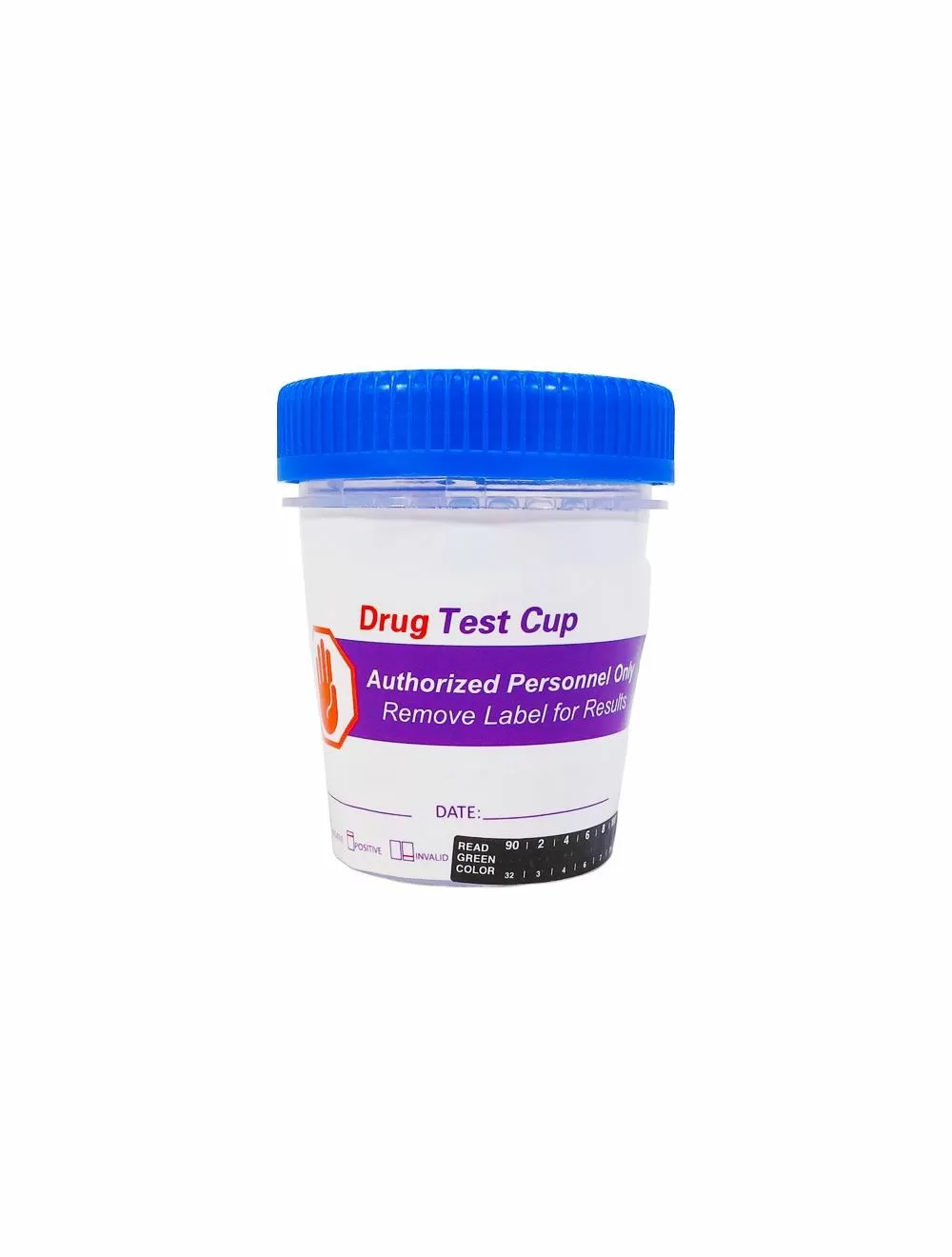


20 Panel Drug Test Cup
- 20-panel test jumbo cup
- Covers a wide array of drugs including specialty drugs such as Fentanyl, Kratom, Gabapentin and ETG, and many others
- An ideal choice for treatment facilities or anyone needing a complete all-in-one test.
- Drugs Tested: THC, COC, PCP, AMP, BZO, BAR, BUP, ETG, FEN, GAB, K2, KET, KRA, MDMA, MET, MTD, OPI, OXY, 6MAM(OXI/SG/PH)
- Forensic Use Only
Availability: In stock
only $91.17 when you buy 275 cases or more.
| Product sold in cases of 25 tests | ||||||||
|---|---|---|---|---|---|---|---|---|
| 1-3 | 4-10 | 11-20 | 21-39 | 40-59 | 60-100 | 101-249 | 250-274 | 275+ |
| $198.75 | $186.25 | $173.75 | $156.38 | $140.74 | $106.37 | $102.94 | $99.72 | $91.17 |
| $7.95 each | $7.45 each | $6.95 each | $6.26 each | $5.63 each | $4.25 each | $4.12 each | $3.99 each | $3.65 each |
| *Discounts may vary based on options above | ||||||||
| Model | Drugs Tested |
|---|---|
| HCDOAEW-6205SA3 | MAM / AMP / BAR / BUP / BZO / COC / KRA / TRA/ / ETG / FEN / GABA / K2 / KET / MET / MDMA / MTD / OXY / PCP / THC + OX / PH / SG |
- Buy 4 for $186.25 each and save 6%
- Buy 11 for $173.75 each and save 13%
- Buy 21 for $156.38 each and save 21%
- Buy 40 for $140.74 each and save 29%
- Buy 60 for $106.37 each and save 46%
- Buy 101 for $102.94 each and save 48%
- Buy 250 for $99.72 each and save 50%
- Buy 275 for $91.17 each and save 54%
You've just added this product to the cart:
20 Panel Drug Test Cup
| All Sales Final | No |
|---|---|
| Avg Competitor Price | $295.00 |
| Per Case | 25 |
| Model | THC50 I COC300 I PCP25 I AMP1000 I BZO300 I BAR300 I BUP10 I ETG500 I FEN300 I GAB2000 I K250 I KET1000 I KRA250 I MDMA500 I MET1000 I MTD300 I OPI2000 I OXY100 I TRA200/6MAM10(OXI/SG/Ph) |
| Panel Count | 20 |
| With Adulterants | Yes |
| Adulterants | Oxidants, pH Balance, Specific Gravity |
| Application Type | urine cup |
| CLIA Waived? | No |
| FDA Cleared | No |
| For Employment and Insurance Use | No |
| Forensic only? | Yes |
How to Use Insight’s 20 Panel Urine Drug Test Cup
PERFORMING THE TEST
Before testing:
Allow the test cup to come to room temperature [15-30℃ (59-86℉)] prior to test.
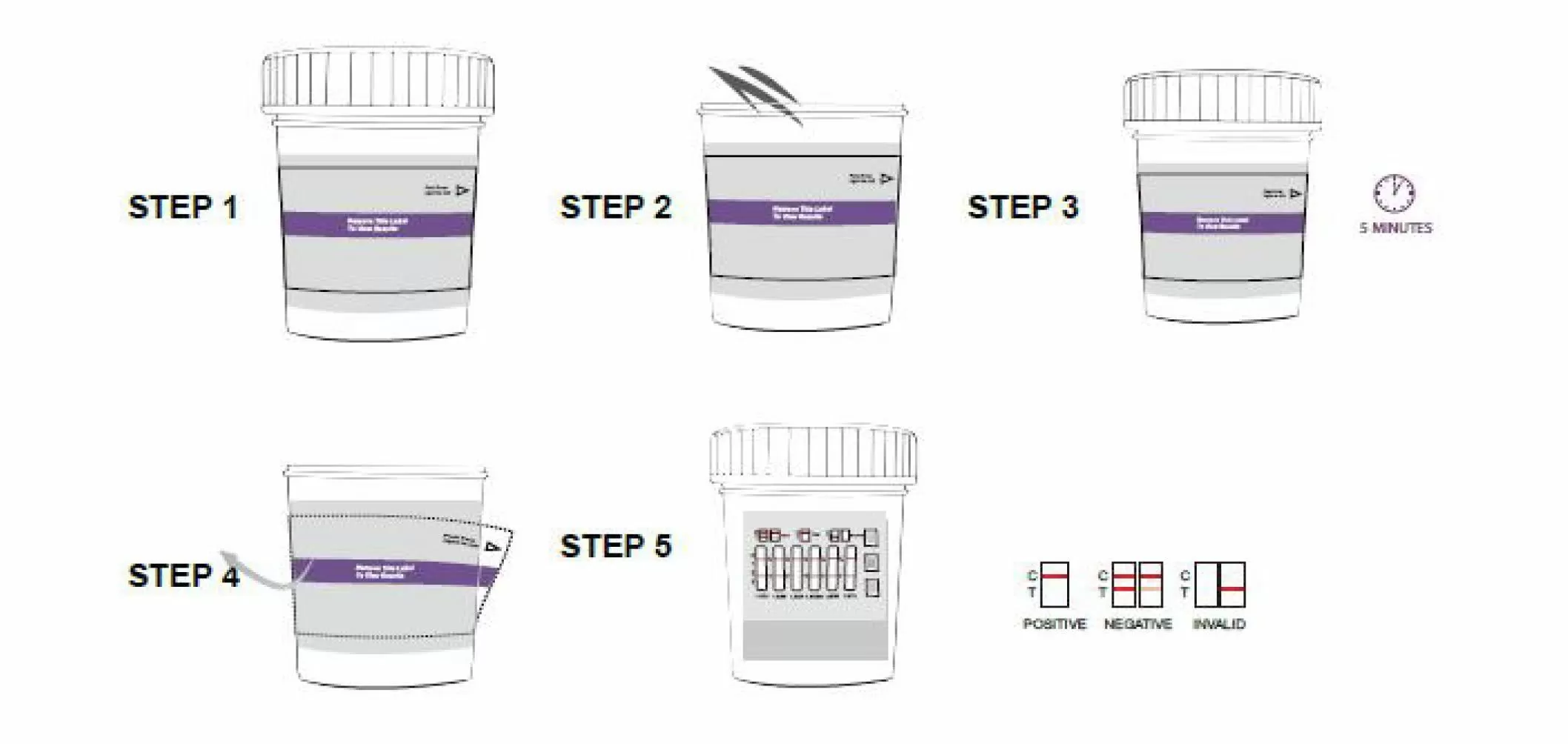
Step 1: Tear the foil bag open, remove test cup and disposable gloves provided for donor. Label the device with donor information. (Fig. 1)
Step 2: Open test cup lid. Urinary directly into the test cup. Be sure to fill up the test cup with the urine specimen between minimum 30ml to maximum 110ml (marked on the cup). (Fig. 2)
Step 3: After urine specimen has been collected, close the lid securely and return cup tp collection official. (Fig. 3)
Step 4: Collection official use glove provided. Peel off label to reveal test result. Read test result at 5 minutes. DO NOT INTERPRET RESULT AFTER 10 MINUTES. (Fig.4&5)
INTERPRETATION OF RESULTS
|
Negative Result NEGATIVE: Two colored bands appear on the membrane. One band appears in the control region (C) and another band appears in the test region (T). Certain lines may appear lighter or thinner than other lines. A line is to be considered a line whether it is faint, light or dark. *NOTE: The shade of red in the test line region (Drug/T) will vary, but it should be considered negative whenever there is even a faint pink line. |
 |
|
Preliminary Positive Result: POSITIVE: Only one colored band appears, in the control region (C). No apparent colored band appears in the test region (T). |
 |
|
Invalid Result: INVALID: Control band fails to appear. Results from any test which has not produced a control band at the specific read time must be discarded. Please review the procedure and repeat with a new test. If the problem persists, discontinue using the kit immediately and contact your local distributor. |
 |
STORAGE AND STABILITY
Store as packaged in the sealed pouch either at room temperature or refrigerated (2-30°C). The Test Device is stable through the expiration date printed on the scaled pouch. The Test Device must remain in the sealed pouch until use. Keep away from direct sunlight, moisture and heat. DO NOT FREEZE, Do not use beyond the expiration date.
ADULTERATION TEST
Urine sample adulteration is usually achieved by substitution, dilution or the addition of adulterants including so-called "masking agents" sold commercially. The use of adulterants can cause false negative results in drug tests by either interfering with the test and/or destroying drugs present in the urine. Dilution may also be used in an attempt to produce false negative drug test results.
The Drug Tests In Bulk PreScreen Plus Test (CLIA Waived) adulteration test is based on the color response of chemical indicators in the presence of adulterants. pH (P), specific gravity (S), oxidant/PCC (O), creatinine (C), nitrite (N) and glutaraldehyde (G) are tested to determine the integrity of urine samples.
pH: The pH determination of urine samples is based on the color change of an indicator in an acidic or basic medium. Normal urine pH ranges from 4 to 9. Values outside of this range may indicate the sample has been altered.
Specific Gravity: The specific gravity test is based on the pKa change of certain pretreated polyelectrolytes in relation to the ionic concentration. In the presence of an indicator, the colors change from dark blue to blue-green in urine of low ionic concentration to green and yellow- green in urine of higher ionic concentration. The normal range for specific gravity is from 1.003 to 1.030. Values outside this range generally indicate specimen dilution or adulteration.
Oxidants/PCC (Pyridinium Chlorochromate): Bleach, hydrogen peroxide, pyridinium chlorochromate or other oxidizing agents react with an oxidant indicator to form a color complex. A blue-green, brown, or orange color indicates adulteration with bleach or other oxidizing agents. Normal human urine should not contain oxidants.
Creatinine: Creatinine reacts with an indicator in an alkaline medium to form a purplish-brown color complex. The normal range of creatinine is from 20 to 300 mg/dl. Values outside this range generally indicate a manipulated test.
Nitrite: Nitrite reacts with the reagents aromatic amine to form a diazonium salt which couples with an indicator to yield a pink-red/purple color complex. A urine sample containing nitrite at a level greater than 15 mg/dl is considered adulterated.
Glutaraldehyde: Adulterants such as "Clear Choice" contain glutaraldehyde which may cause disrupting the enzyme used in some immunoassay tests. Glutaraldehyde is not normally found in human urine.
FAQ About the 20 Panel Drug Test Cup
What Drugs Does the 20 Panel Drug Test Cover?
This 20 panel drug test cup screens for the following substances and groupings: MAM, AMP, BAR, BUP, BZO, COC, KRA, ETG, FEN, GABA, K2, KET, MET, MDMA, MTD, OPI, OXY, PCP, THC, and TRA + OX / PH / SG. It is designed to detect both common drugs of abuse and specialty substances in a single test.
Is This a 20 Panel Urine Drug Test?
Yes. This is a 20 panel urine drug test cup that uses a single urine specimen to provide rapid, on-site screening results across all included drug panels.
Who Is the 20 Panel Drug Test Cup Designed For?
The 20 panel drug test cup is designed for treatment facilities, rehabilitation centers, halfway houses, and other organizations that require comprehensive screening in a single all-in-one test. It covers a wide array of drugs, including specialty substances such as Fentanyl, Kratom, Gabapentin, and ETG, making it a practical option for programs that need broad detection without using multiple test formats.
Does the Test Include Adulteration Detection?
Yes. The Insight 20 Panel Drug Test Cup includes built-in adulteration checks to help identify diluted or tampered specimens, supporting more reliable screening results.
How Quickly Are Results Available?
Results are typically available within minutes after specimen collection, allowing for immediate screening decisions when used according to the instructions.
What Is the Difference Between a 20 Panel Drug Test and Lower Panel Tests?
A 20 panel drug test screens for a wider range of substances than 5-panel or 10-panel tests, including specialty drugs such as Fentanyl, Kratom, Gabapentin, and ETG, which are not always included in standard panels.
Is This Test Suitable for DOT or Regulated Testing?
This product is intended for forensic use only and is not approved for DOT-regulated testing. Always confirm testing requirements before selecting a drug screening product.
Is the 20 Panel Drug Test Cup Easy to Use?
Yes. The all-in-one cup design allows for straightforward specimen collection and interpretation without the need for additional testing components.
| Model | Drugs Tested: |
|---|---|
| HCDOAEW-6205SA3 | 6MAM10, AMP1000, BAR300, BUP10, BZO300, COC300, KRA250, TRA/100, ETG500, FEN, GABA1000, K2(50), KET1000, MET1000, MDMA500, MTD300, OXY100, PCP25, THC50 |
| Drug Name | ABBR | Calibrator | Standard Cutoff Levels Urine | Standard Cutoff Levels Saliva | Approx. Detection Time Urine | Approx. Detection Time Saliva |
|---|---|---|---|---|---|---|
| Alcohol |
ALC |
Ethanol |
>0.04% |
>0.02% |
1-12 hours |
1-12 hours |
|
** |
AMP |
** |
500 & 1000 ng/ml |
50 ng/ml |
2-4 Days |
1-3 Days |
|
Barbiturates |
BAR |
Secobartbital |
300 ng/ml |
50 ng/ml |
1-3 Days |
1 Day |
|
Benzodiazepines |
BZO |
Oxazepam |
300 ng/ml |
10 ng/ml |
3-5 Days |
1 Day |
|
Buprenorphine |
BUP |
Buprenorphine |
10 ng/ml |
5 ng/ml |
3-5 Days |
1 Day |
|
Cocaine |
COC |
Benzoylecgonine |
150 & 300 ng/ml |
20 ng/ml |
2-4 Days (Single) |
1-3 Days |
|
Cotinine |
COT |
Cotinine |
200 ng/ml |
30 ng/ml |
1-3 Days |
1-4 Days |
|
Ecstasy |
MDMA |
D,L- Methylenedioxy-methamphetamine |
500 ng/ml |
NA |
1-4 Days |
1-2 Days |
|
Ethyl Glucuronide |
ETG |
Ethyl Glucuronide |
300 & 500 ng/ml |
NA |
Up to 80 Hours |
N/A |
|
** |
FEN |
** |
200 & 300 ng/ml |
10 ng/ml |
3 Days |
N/A |
|
Gabapentin |
GABA |
Gabapentin |
1000 ng/ml |
N/A |
1-2 Days |
N/A |
|
K2 / Spice |
K2/Spice |
JWH-073/JWH-018 |
50 ng/ml |
5 ng/ml |
1-3 Days |
N/A |
|
Ketamine |
KET |
Ketamine |
1000 ng/ml |
N/A |
1-3 Days |
1 Day |
|
Marijuana |
THC |
11-nor-Δ9-THC-9 COOH |
50 ng/ml |
12 ng/ml |
2-5 Days (Single) |
|
|
Methadone |
MTD |
Methadone |
50 ng/ml |
30 ng/ml |
1-7 days |
1 Day |
|
Methamphetamine |
MAMP |
D-Methamphetamine |
500 & 1000 ng/ml |
50 ng/ml |
2-4 Days |
1-3 Days |
|
Morphine |
MOP |
Morphine |
300 ng/ml |
40 ng/ml |
1-3 Days |
1-3 Days |
|
Opiates |
OPI |
Morphine |
2000 ng/ml |
|||
|
Oxycodone |
OXY |
Oxycodone |
100 ng/ml |
20 ng/ml |
1-3 Days |
1 Day |
|
Phencyclidine |
PCP |
Phencyclidine |
25 ng/ml |
10 ng/ml |
2-13 Days |
1-3 Days |
|
** |
TRA |
** |
200 ng/ml |
NA |
1-3 Days |
1 Day |
|
Tricyclic Antidepressants |
TCA |
Nortriptyline |
1000 ng/ml |
NA |
2-5 Days |
N/A |
|
Propoxyphene |
PPX |
Propoxyphene |
300 ng/ml |
NA |
1-7 Days |
N/A |
|
*The above chart gives approximate detection periods for each substance by test type. The ranges depend on amount and frequency of use, metabolic rate, body mass, age, overall health, drug tolerance, urine pH, and other additional factors |
||||||